
Your First Time in the Cook Islands

Fifteen islands, some fifteen thousand people and an ocean territory about the size of Mexico: the Cook Islands have less dry land between them than New York City, and they spend every acre of it generously. Rarotonga rises green and volcanic out of a reef-ringed lagoon, Aitutaki floats in water so blue it looks retouched, and the outer islands keep traditions the rest of the Pacific has quietly let go. The country greets you with two words, kia orana, which mean "may you live long." Stay a while and it starts to sound like advice.
What to Expect
Almost everyone lands at Rarotonga International Airport, just west of Avarua, a capital small enough to feel like a village. Rarotonga is 32 kilometers around, you can circle it in under an hour, and by local custom nothing here is built taller than a coconut palm. Give Rarotonga four or five nights, Aitutaki at least three, and if you can spare them, two or three more on an outer island, where the pace drops by half again. Set your watch to Hawaii time; the Cook Islands keep the same clock.
Rarotonga's two roads tell you most of what you need to know about the island. The coastal Ara Tapu is the one everybody drives, and it has exactly two bus routes: Clockwise and Anticlockwise. Flag one down anywhere along the way and it will carry you all the way round in about fifty minutes. Inland runs the older road, the Ara Metua, which tradition says the chief Toi had paved in stone around the eleventh century. It winds past taro patches and family gardens to Arai-te-Tonga, the most sacred marae on the island, where chiefs were once invested. Rent a bicycle and ride the old road. It is quieter, shadier and a thousand years older.

Muri Lagoon on the southeast coast is where Rarotonga shows off. The reef holds the surf at a distance, the water inside stays shallow and glassy, and a handful of small motu (islets) sit close enough to paddle to. Take a kayak or a glass-bottom boat out in the morning before the trade wind picks up, then snorkel straight off the beach in the afternoon.
The Cross-Island Track is the walk to do if you do only one. It climbs through rainforest to the base of Te Rua Manga, the Needle, a spike of volcanic rock that watches over the whole island, then drops down the south side to Wigmore's Waterfall. Allow three to four hours, go with a guide or at least in dry weather, and expect roots that turn slick the moment it rains.

Punanga Nui Market fills the Avarua waterfront every Saturday morning with tropical fruit, black pearls, ukuleles and pareu, the wrap sarongs worn here by nearly everyone. Arrive early; the best stalls are packing up by lunchtime.
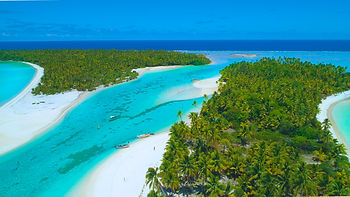
Aitutaki is the reason many people come at all. It sits a short flight north of Rarotonga, and its lagoon is a vast triangle of turquoise ringed by reef and scattered with tiny islands. Join a lagoon cruise to Tapuaetai, One Foot Island, a strip of white sand barely half a kilometer long with a hut of a post office that will stamp a small footprint into your passport. An unofficial stamp can raise questions at some borders, so have it pressed onto a postcard instead and mail it home from the most remote post office you are ever likely to visit.
Atiu is the island for travelers who want the Pacific without the polish, and it is a short flight from Rarotonga on Air Rarotonga. The highlight is Anatakitaki Cave, reached on a guided walk through jungle and fossilized coral. The cave is home to the kopeka, a tiny bird found nowhere else on earth. Like bats, these birds find their way in the dark by echolocation, so you hear them clicking overhead long before you see them. The tour finishes with a candlelit swim in an underground pool.

Where to Eat and Drink
Start with ika mata, raw fish cured in lime and folded into coconut cream with cucumber and onion. Order rukau, taro leaves slow-cooked in more coconut cream, and anything that comes out of an umu, the earth oven where pork, taro and breadfruit steam for hours beneath banana leaves and hot stones. The easiest way through all of it is an Island Night: a feast followed by drumming and dancing, and Cook Islands drummers are counted among the finest in Polynesia. On Atiu, ask about a tumunu, the bush beer that emerged after the missionaries banned alcohol. Wait to be invited, never refuse the cup, and pace yourself. Then bring home a bag of Atiu coffee, grown on the island and roasted a short walk from where you'll drink it.
If the Cook Islands are calling, and they should be, I'd love to help you shape the trip. Schedule a consultation with me and let's build it around the pace island time was made for.

Comments