
Your First Time in Maastricht

Updated: Sep 24
Maastricht sits closer to Brussels and Cologne than it does to Amsterdam, and it has never much minded. Roman soldiers forded the Maas here, prince-bishops built over the top of them, and the city that came out the other end eats like Burgundy, prays like Rome, and speaks a dialect the rest of the Netherlands finds charming and largely unintelligible. It is one of the oldest cities in the country and, by some distance, the least Dutch.
What to Expect
The train station sits in Wyck on the east bank and the old town is on the west, which means your first act in Maastricht is walking across a bridge — the correct way to arrive anywhere. Almost everything worth seeing is within twenty minutes on foot of that crossing. Give the old town a full day, the hill south of the city half of another, and one evening to a terrace, because that is what the locals do with theirs.

The Sint Servaasbrug is long billed as the oldest bridge in the Netherlands, and it exists because the one before it failed catastrophically. In 1275 a religious procession crossed the old wooden bridge in a body and it gave way beneath them; tradition puts the toll at around four hundred. The stone replacement went up between 1280 and 1298 and has been patched together more than once since — a German demolition unit brought part of it down in 1944 — but its seven arches still carry you into the old city on foot, which remains the only way across.
The Vrijthof is the square everyone means when they say they'll meet you in town, and it was a burial ground long before it was a row of terraces; excavations under the cobbles turned up cemeteries going back to the late Roman period. On its north side, the Basilica of Saint Servatius stands over the grave of a bishop whose death is traditionally dated to 384. Christians have worshipped on this spot for something like sixteen centuries, and the treasury still holds the twelfth-century gilded reliquary chest that was carried through the streets in times of plague, siege and flood.

Boekhandel Dominicanen is a bookshop inside a Gothic church, and it is worth planning an afternoon around. The Dominicans began building in about 1265; after the friars were turned out, the nave did time as a city archive, a post office and a bicycle shed. In 2006 an architecture practice slid a multi-level black steel book stack into the nave, so you now climb up inside the church to browse. Order a coffee in what used to be the priests' choir and go find the 1337 wall painting of Thomas Aquinas, said to be the oldest church mural in the country.
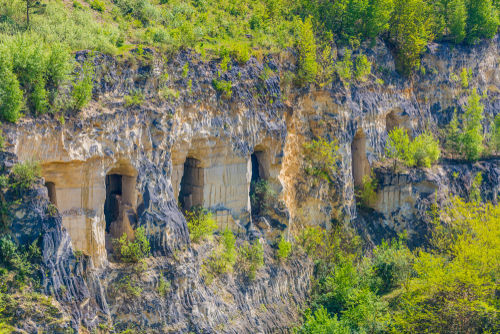
The Sint-Pietersberg caves are not caves at all. They are marl quarries, cut by hand out of the soft limestone since the Middle Ages, and at their greatest extent more than twenty thousand passages ran through the hill. During the war a concrete vault hidden inside them held some 750 artworks, the Night Watch among them. You cannot wander in alone — people have gone in without a guide and not come out — so book a tour, and take a jacket, because it is about 50 degrees Fahrenheit down there in August. Fort Sint Pieter sits on top of the same hill, pentagonal, built of marl (a type of rock) and brick in 1701, with the best view back over the city you'll get.
Onze Lieve Vrouweplein is the quieter square, and the better one to take a table on. It was a churchyard once, and the Basilica of Our Lady on its edge has a westwork raised shortly after the year 1000 and a candle chapel that draws visitors by the hundred every day. Then there is the detail nobody expects. Dig under the hotel on the corner and you hit a Roman sanctuary with a Jupiter column, second and third century, excavated in 1983 and left exactly where it was found. The hotel built its basement around it, and you can arrange with the front desk to go down and stand in front of it.

Where to Eat and Drink
Eat Limburgish, and eat it slowly — Maastricht calls itself bourgondisch and means it. Zoervleis is the dish to order: a sweet-sour braise — horse meat by tradition, beef more often now — soured in vinegar, then thickened and sweetened again with apple syrup and melted gingerbread, and served with frites. Vlaai is the one to bring home — an open fruit tart on a thin base of sweet yeast dough rather than pastry, protected under EU law since 2024, and so woven into Limburg life that one flavor is traditionally served at funerals. For both, walk into the Jekerkwartier to the Bisschopsmolen, a working water mill on the Jeker that still grinds its own spelt and bakes with it out front. Then find a terrace on the Vrijthof and give the afternoon up gracefully.
If Maastricht is the start of a longer journey through the Low Countries — and it should be — I'd love to help you shape it. Schedule a consultation with me and let's build the trip around the pace you actually want to travel at.


Comments