
Your First Time in Fiji

Fiji is more than three hundred islands scattered across the South Pacific, and about a third of them are lived on. You hear the country before you see much of it: bula, the greeting that means hello, welcome and good health all at once, called out by airport staff, bus drivers and children on the beach. Most travelers picture a resort pool and a sunset, and Fiji does both beautifully. Look a little further and you find village ceremonies, Hindu temples, a colonial port town frozen in the 1800s and some of the finest coral reefs on earth.

Exploring Viti Levu
Nadi deserves more than a transit night. At the south end of town, the Sri Siva Subramaniya Temple is one of the largest Hindu temples in the Southern Hemisphere, with painted ceilings and brightly carved deities in the traditional South Indian style. The temple is a reminder that roughly a third of Fijians trace their roots to India, many descended from laborers the British brought over between 1879 and 1916. Remove your shoes and cover your shoulders before you go in. North of town, the Garden of the Sleeping Giant holds a large orchid collection at the foot of the Nausori Highlands, a garden first planted by the actor Raymond Burr.

The Coral Coast runs along the south shore of Viti Levu, about an hour from Nadi. At Sigatoka Sand Dunes National Park, Fiji's first national park, the wind has uncovered pottery left by some of the earliest people to reach the Pacific. Further east at Pacific Harbour, you can watch firewalkers from Beqa Island cross a pit of hot stones barefoot, a tradition the Sawau people have kept for generations.

A village visit is the experience most people remember longest. Custom asks you to bring a gift of kava root, called a sevusevu, which the chief accepts on behalf of the village before you are welcomed in. Cover your shoulders and knees, take off your hat, and never touch anyone's head, which Fijians consider sacred. Go with a local guide or ask your resort to arrange the introduction.
Island Escapes
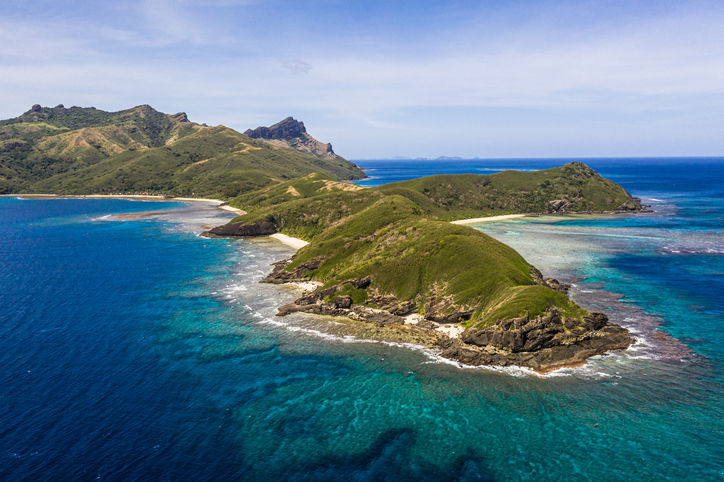
The Mamanuca and Yasawa Islands are the Fiji of postcards. The Mamanucas sit a short boat ride off Nadi, close enough for a day trip and polished enough for a week of doing nothing well. Monuriki, the uninhabited island where Cast Away was filmed, is among them. The Yasawas stretch north in a long, rugged chain, with fewer resorts and emptier beaches. A daily catamaran works its way up both groups, dropping guests island by island.

Taveuni is called the Garden Island, and one look at it explains why. Offshore, the Rainbow Reef and its Great White Wall draw divers from around the world, because Fiji is known as the soft coral capital of the world and this is where it proves it. On land, Bouma National Heritage Park has rainforest trails to the Tavoro Waterfalls, each with a swimming hole at its base. The 180th meridian crosses the island too, and a sign marks the spot where you can stand with one foot in each day.

Levuka on the island of Ovalau was Fiji's first colonial capital until 1882, and it has changed remarkably little since. Wooden shopfronts line Beach Street, the old churches still ring their bells, and the whole town is a UNESCO World Heritage Site. Stay one night and you will likely have it almost to yourself.
If Fiji is calling, and it should be, I'd love to help you shape the trip. Schedule a consultation with me and let's build it around the pace Fiji time was made for.


Comments